Saturday, December 15, 2012

New Experiences


I started working for The Veterinary Cancer Center roughly 3 months ago as the new Referral Coordinator.  When I started with The Veterinary Cancer Center a few short months ago, I had no idea how incredible this place was and the profound impact The Veterinary Cancer Center has played in so many people’s lives.  I came to The VCC with no prior medical knowledge or veterinary experience looking for a new challenge, and to find a career that I could be passionate about.  What I found when I got her was all of that and so much more. 

As I mentioned, I do not have a background in veterinary medicine and, to be completely honest, I never would have thought my career path would have brought me to The VCC,  but I am fortunate that it did.  I have spent a large part of my career in sales, marketing and management so the question I am often asked is “How did you end up working at The Veterinary Cancer Center.”  Well the answer to that question is easy… I love animals and I was presented with an opportunity to be part of a place that helps pets and their owners during a very difficult time.  The VCC provides hope to pets and their owners when, often times, there is very little and that is something not only to be passionate about,  but to be proud of. 

During a time when so many people are either looking for a job, or find themselves in a job that does not make them happy,  I am extremely thankful that I was brought in to be part of The VCC team.  Almost everyone I know either has had a pet with cancer or knows someone that has so,  I am very familiar with how difficult it can be.  It can be one of the hardest things to deal with and to know that I work for a place that will do everything to provide hope for the pet and the owner is pretty powerful.  For those of you that have a hard time believing what you reading, I urge you to come down to The Veterinary Cancer Center and see for yourself.  Once you do, I assure you, that you will be just as amazed as I was when I walked through the door.      

Saturday, December 8, 2012

When the Doctor Becomes the Patient


     Cancer is a scary word. Usually I am the one giving the diagnosis or discussing the prognosis and treatment with heart broken pet owners. It is a lot different when my pet is the one with the diagnosis and I am the one hearing about the prognosis and treatment. Two of my own dogs have previously been diagnosed with and treated for cancer. As a pet owner it was devastating for me but as a veterinarian it was an invaluable lesson into the emotional roller coaster my clients endure on a daily basis. 

     As many of my clients and friends know, I love basset hounds! My current basset hound, Walter, is my third basset. I got Walter about 2 years ago, several months after losing my second basset, Kirby. Kirby was a "special needs" basset hound, whom at 8 years of age found himself in search of a new home. I found Kirby (or maybe he found me) when he was almost nine. We had 3 and a half great years together when he was diagnosed with lymphoma. I was devastated, but as a fourth year veterinary student I knew a few things about lymphoma and took Kirby to see an oncologist right away. I already knew that I wanted to be as aggressive as possible while maintaining Kirby's excellent quality of life. Kirby was quickly started on an injectable multi-agent chemotherapy protocol (the CHOP protocol). As a vet student I knew that Kirby's lymph nodes were supposed to shrink quickly and return to normal after receiving his first treatment. I checked his lymph nodes multiple times a day waiting for them to get smaller. But days went by with no change, he had further treatments, weeks went by and still no change. Kirby still felt great and was handling his chemotherapy well but his lymph nodes were not budging. I was again devastated, the chemotherapy was not working. 

    But I wouldn't give up and neither did Kirby's oncologist. We decided to switch to a different treatment protocol, one in which Kirby received oral medications by mouth daily. Again, I hopefully felt his lymph nodes every day, willing them to get smaller. Again, there was no change in the size of his lymph nodes. I was starting to feel defeated, but lucky for me and for Kirby, his oncologist was not defeated. We switched Kirby to yet another treatment protocol. Full of new hope, I continued my ritual of daily lymph node palpation. This time it worked! Kirby's lymph nodes were normal and he still felt great! I was beyond thrilled. Not only did the new protocol give me 5 additional months with Kirby (who sadly was euthanized for a reason unrelated to lymphoma) but I also learned an important lesson; never give up hope. Sometimes hope is all we have, we hope that the next treatment will work, we hope that our friends continue to feel well during treatment and we hope that when the time comes to say good bye it is peaceful. Kirby and his doctors taught me a lot and because of them I will always have hope for my patients and my clients.


Wednesday, December 5, 2012

The Missing Link

As I toyed with the idea of going back to school to become a Registered Nurse (for humans), I found myself teetering between an unwillingness to leave veterinary medicine and a desire to further my education in order to elevate my level of medical knowledge and clinical skills.
 
It seemed that the more I learned here, at The VCC, the more that I realized how fascinating the field of Oncology was. I would hear Dr. Post frequently referencing human Oncology literature and I started to appreciate the undeniable link between veterinary and human Oncology.

I realized that going to Nursing School did not mean that I was going to be forced to make a choice between animals and people. It was becoming clear that Oncology was Oncology and that really, there didn’t need to be a line drawn between the species that I would work with.

Now that I have graduated and am proud to be both a Licensed Veterinary Technician and a Registered Nurse, it is all starting to come together with my new role as Clinical Trial Coordinator.

Maybe you’re wondering what it is that a Clinical Trial Coordinator actually does…. Check out my next blog to hear more about I get to help patients receive cutting edge treatment (sometimes for free) while at the same time helping to further research for animals and humans with cancer!
 
Maria Salas, LVT, RN,  Clinical Trial Coordinator for VCC

Saturday, December 1, 2012

LEXI


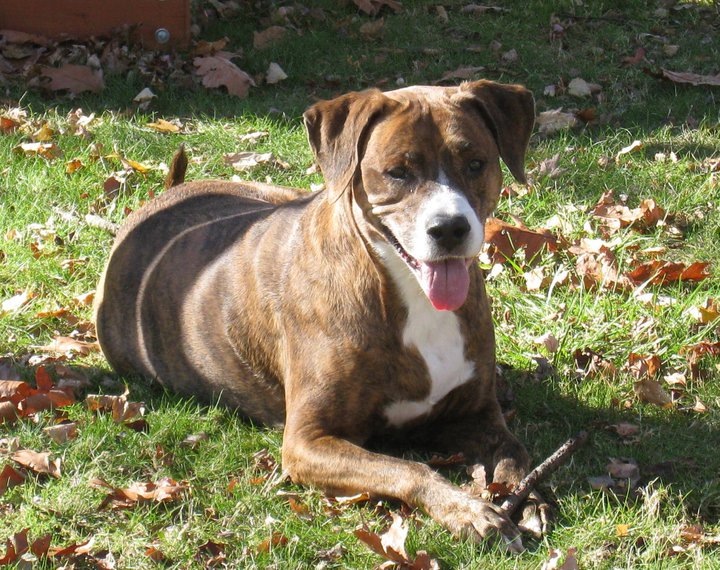
I brought Lexi home as an 8 week old puppy in November 2001. She was a beautiful brindle boxer/pit bull mix who got me in quite a lot of trouble with my landlord, as I wasn’t allowed to have pets in my building – as any true pet lover knows, rules about animals are merely suggestions that don’t necessarily need to be followed! We always had fun rollerblading when we lived in Hamden, she would wear a harness and drag me sled-dog style down the bike trail, and when I moved into Fairfield, St. Mary’s in Black Rock became our new favorite place to hang out – she loved to swim in the marsh at high tide. Her brother Roscoe, a boxer, came into our lives in 2004, and she had a constant companion from then on. She lived a very comfortable doggy life in our home in Stratford, we have a big yard where her and Roscoe ran and played, and a big couch to spread out on inside. Her tail would wag so hard she would leave bruises on your leg (and knock more than a few things off the coffee table). Anyone who knew Lexi knew her tail.

In April of this year, I came home to find my previously perfectly healthy dog had a distended belly, and my 10 years of training in veterinary medicine told me that something really bad was going on – despite the still wagging tail. Cancer was at the top of my list of “what could be wrong,” and unfortunately, I was right. I said goodbye to Lexi in July, but she didn’t go down without a fight, and her tail never stopped wagging. I’ll talk more about the path we took through emergency surgery and aggressive chemotherapy next time. For now, I want to share one of my favorite pictures of her with you. Thanks for taking the time to follow our story.

Saturday, November 24, 2012

November has been renamed “Movember”


No, that is not a typo.  November is Prostate Cancer Awareness Month and an international movement started in Australia, Movember—was started in 2003. Movember events have raised $126 million since 2003, with all the funds donated to charities that target men’s health issues-- the Prostate Cancer Foundation and LIVESTRONG Foundation.

Prostate cancer does not just affect men; dogs also get this form of cancer. It is thankfully an uncommon disease, but it does occur in both neutered and intact dogs. The signs of prostate cancer in dogs are straining to urinate, bloody urine, back pain, and/or straining to defecate. Diagnostic tests include a good physical examination (including a rectal examination), urinalysis, abdominal radiographs, abdominal ultrasound, and a biopsy or cytology to confirm the diagnosis.

Therapy for prostate cancer in dogs is different from treatment in men. As all of the prostate cancers in dogs are androgen-independent, anti-androgen (anti-testosterone) therapies do not work. In addition, the cancer in dogs is usually highly malignant. Surgical removal of the prostate gland in dogs is very difficult and is only effective when the tumor is detected at a very early stage. The typical therapy involves NSAIDS (non-steroidal anti-inflammatory drugs), chemotherapy and radiation therapy. The Veterinary Cancer Center in Norwalk, CT (www.vcchope.com) conducted research on the use of chemotherapy in dogs with prostate cancer and is gearing up to continue that research by evaluating the use of highly targeted radiation therapy--IMRT (Intensity-Modulated Radiation Therapy) for the treatment of this disease.

How you can help---Please visit http://us.movember.com/team/777069 and donate to our Team. The money raised will help find an end to this all too common and devastating disease of men (and dogs).
Dr. Gerald Post

Saturday, November 17, 2012

Sammy's Story

In this month's Blog I would like to pay tribute to a very special little beagle named Sammy. I was blessed to have been given the opportunity to meet, care for, and grow to love Sammy. Sammy was super resilient boy who battled a severe heart condition in addition to the bladder cancer I was treating him for. He fought hard, had a fabulous quality of life, and constantly proved me wrong by outliving all the predicted survival times for his condition. Sammy was blessed to have a wonderful human family that loved him immensely and took amazing care of him. Sadly, Sammy lost his battle in July 2012.
Below is “Sammy's Story” authored by his human parents. It is a wonderful tribute to his life and it proves how often animals actually end up rescuing us when we think we are rescuing them.

Dr. Gina Olmsted


   On Sunday, July 22, Sammy, our sweet Beagle, passed away at home, surrounded by those who loved him.
We'll never forget when we first saw his adorable face. We brought dog and cat food to the Animals for Life shelter in Middlebury, CT one Saturday morning in February, 2010, and as we walked through looking at all the dogs, there he was, quietly sitting on his haunches, one paw up against the cage door, calling to us with his eyes."I belong to you", he was saying.  We filled out an application, but were told that another family was ahead of us. But fate would bring him to us instead. When Sue brought Mac to the vet to be neutered, (that was the name they had given him) she discovered that he had a heart murmur and would need daily medication.  When the other family heard this, they no longer wanted him, and so Sammy found his forever home with us.

  He was sweet and funny and cuddly and a bit of a devil. He loved his walks and his couch and his stuffed lion and llama, which he "stole" from the stuffed animal basket.  And he adored his people. His heart and lungs got progressively worse, but it didn't slow him down. With the help of his local cardiologist, as well as the chief
cardiologist at the Animal Medical Center in New York City, he was stabilized.

  Then on December 10, 2011, we received the devastating news that Sammy had a tumor in his bladder. A wonderful internist at VCA Shoreline Veterinary Referral and Emergency Center in Shelton, CT diagnosed it, and that same day we had the good fortune to meet Dr. Gina Olmsted, an oncologist from the Veterinary Cancer Center in Norwalk, CT. She became not only Sammy's oncologist, but a dear friend who loved Sammy so much.  We tried 3 months of different protocols, including intravenous chemotherapy, but the tumor wasn't shrinking.  So together with Dr, Olmsted, we made the decision to stop all treatment.  His kidney function was very poor, but much to every one’s surprise, he rebounded, got a second wind, and had 4 more excellent months.
 
   We believe that he knew how much we needed him to stay with us through July.  My father's funeral was July 14, and by July 19 my nephew and sister, who were here from the west coast, had left to go home.  The house quieted down, and then Sammy began to slow down. For 3 days we were constantly with him, every moment of the day and night.  He wasn't eating any longer, nor could he take his walks, but he loved being outside on the grass and sleeping with us at night.

On Sunday, July 22, he spent most of the day outside on the grass, and we took turns staying there with him. By early afternoon he let us know that he did not want to be outside any longer, and he stumbled to the front door.  I carried him inside, and put him on a soft bed in the entry, but he was very restless.  Finally, he tried valiantly to walk to his couch, and so I gently picked him up and laid him in a comfortable position. At 5:10pm, he took his last breath, and went over the Rainbow Bridge.

   Over the past years we have loved a Springer Spaniel, a Collie, 2 Basset Hounds, a Flatcoat Retriever, and 2 mixed breeds, but none ever stole our hearts like this little Beagle.  We are heartbroken and bereft, and wait for him to come trotting around the corner.  We are so grateful to everyone who walked with us and Sammy on his difficult journey –  His local veterinarians and cardiologist, the veterinarians and staff at Shoreline and Animal Medical Center, and Dr. Gina Olmsted and the staff of the Veterinary Cancer Center.

We have been told by so many people how blessed Sammy was to have found such a loving home and such devoted parents like us.  But we are the ones whose lives were touched and blessed by the gift of this loving, adorable Beagle.

-Helen and Karen


Wednesday, November 7, 2012

“You can give chemotherapy to dogs like in humans?

I’ve been working in the veterinary medical field for a little over 10 years.  General practice, emergency, specialty dentistry, exotics, it seems like I’ve seen and done it all until I started working at The Veterinary Cancer Center. I’m from a small town in Texas where I feel that it is unheard of to treat an animal that has cancer. The common perception that I hear the most when people learn that I work at a Specialty Oncology Center is “Dogs can get cancer?”  Or my personal favorite; “You can give chemotherapy to dogs like in humans?  Or “You have the capability to radiate tumors too? “ The answer is yes you can.  I can honestly say that I had the same view and attitude but I came to realize the sheer science, beauty, and what a discipline veterinary oncology entails. My primary role in the hospital is Radiation Therapy, where I work alongside Tara, Rosie, and Dr. Farrelly. Dr. Farrelly is one of the few veterinarians in the country that is a double boarded in Radiation Oncology through the American College of Veterinary Radiology and Medical Oncology through the American College of Internal Medicine (Oncology). It is a true honor to learn and work with him.

Like I said before, Veterinary Oncology is a very interesting and amazing niche in veterinary medicine and Radiation Oncology is an even smaller niche that I find even more amazing. With my limited experience in the field I can say that I’ve seen some amazing and inspirational things being done. My personal philosophy is that I devote my life and time to my animals and I’m trusted in the care of your animal as a veterinary technician and want provide the best care possible. So when I see an animal that is clearly in pain or not feeling well due to a cancer, I want to see results just as you do. By working with Dr. Farrelly in the Radiation Oncology Department, I see animals that are in pain, but after a couple weeks of treating these patients, I feel like I can see the relief and see that they feel better.  Sure, the side effects of radiation are there, but getting down to the root of why we’re treating, we are potentially curing and prolonging an animal’s life. We can always treat the side effects (that’s the easy part).  Next month I’ll present one of these cases and show you firsthand the “awesomeness” of what we do for your pet.  Until then, continue to Hope, and we’ll continue to give Hope to your pet.

-Stephen Renner